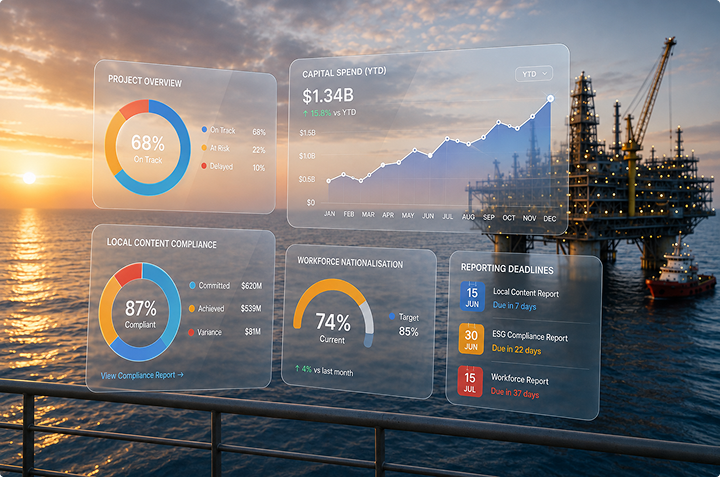
Large capital projects in oil and gas, from refinery expansions to LNG terminals and petrochemical complexes, are among the most capital-intensive undertakings in the global economy. GlobalData currently tracks oil and gas construction projects worth a combined $3.8 trillion globally, with the Middle East and North Africa alone accounting for a $980 billion pipeline and annual spend expected to climb toward $471.3 billion in 2026 and $700 billion in 2027, according to GlobalData’s Q4 2025 market analysis. Yet the scale of investment has not solved the industry’s oldest problem: leadership teams routinely make decisions worth hundreds of millions of dollars using information that is days, or even weeks, out of date. This article examines why decision latency persists on megaprojects, what regulators now expect from local content and compliance reporting, and how real-time reporting is closing the gap between what happens on the ground and what leadership actually sees.
The scale of the decision-latency problem
Megaproject performance data is sobering. McKinsey’s review of more than 300 billion-dollar-plus megaprojects found average cost overruns of roughly 80 percent and schedule delays of around 50 percent, while a broader study of over 500 projects worth at least $100 million each recorded cost overruns averaging 79 percent and delays averaging 52 percent, as reported in McKinsey’s analysis of at-risk capital projects. More than 90 percent of major projects experience schedule delays or cost overruns, with 98 percent of megaprojects overrunning budgets by more than 30 percent, according to the same McKinsey research on infrastructure delivery. These are not simply engineering or market failures; they are, in large part, information failures.
Research from infrastructure monitoring specialist Encardio found that 91.5 percent of megaprojects fail to meet their targets because of fragmented monitoring data and delayed decisions, noting that “the most common failure in monitoring isn’t bad sensor calibration; it’s fragmentation, separate spreadsheets, separate dashboards, and readings that don’t line up with construction events,” per Encardio’s analysis of infrastructure project failure. The pattern is consistent across the sector: most projects have monitoring systems, but very few have integrated decision workflows that turn data into timely executive action. For local content managers and compliance teams specifically, this fragmentation is compounded by the fact that supplier spend, workforce localisation figures, and training data typically sit in separate spreadsheets maintained by separate teams, reconciled manually, and reported up the chain on a cadence dictated by when someone has time to compile it rather than when leadership needs to see it.
Why local content and compliance data lags on capital projects
Procurement and compliance functions on megaprojects are especially exposed to this problem. Industry analysis of procurement operations notes that reporting “requires many hours, if not days, of reconciliation rather than high value analysis and insight when data is spread across regions and functions,” and that reports are frequently “outdated by the time they reach the CFO’s desk” because manual spreadsheets leave no clear record of who approved what, when changes were made, or why particular suppliers were selected, as detailed in industry commentary on why CPOs get caught out by supplier spreadsheets. Organisations moving away from spreadsheet-based tracking toward digital procurement platforms report cycle-time reductions of up to 65 percent, illustrating just how much latency spreadsheets and email threads add to a reporting cycle, based on findings summarised in Spendflo’s guide to procurement reporting.
For local content teams, the stakes are higher still, because the audience for the data is not only internal leadership but external regulators with statutory deadlines and, increasingly, audit rights. When the underlying data is stale, executives are not just making suboptimal operational calls; they risk submitting compliance figures that do not reconcile with the audited numbers regulators later request.
What regulators now expect: cadence, verification, and audit readiness
Local content regulation has matured considerably, and reporting expectations have hardened accordingly. In Nigeria, the Nigerian Content Development and Monitoring Board (NCDMB) requires operators and contractors to engage the Board at multiple mandatory points across a contracting cycle, from Nigerian Content Plan submission through to the Nigerian Content Compliance Commitment, and companies must report quarterly on research and development activity against their approved plans. In total, the Board expects 14 statutory reports from companies, and late or incomplete submissions remain the most common compliance failure, according to NCDMB’s monitoring and evaluation guidance. Compliance teams tracking these obligations in spreadsheets are, in effect, trying to hit 14 separate statutory deadlines using a manual process that was never designed for that volume of reporting.
Saudi Aramco’s iktva (In-Kingdom Total Value Add) programme sets an equally demanding standard. Suppliers must self-report on an ongoing basis across categories including localised goods and services, Saudi salaries, training and development, supplier development spend, local R&D, and revenue, and that data must be verified by an Aramco-approved external accountant before it feeds into a supplier’s IKTVA score, which directly affects competitiveness in future tenders, as explained in Al Tamimi’s guide to the IKTVA programme. The programme’s scale underlines why continuous, audit-ready data matters: Aramco announced in February 2026 that iktva had reached its 70 percent local content target, having already contributed more than $280 billion to Saudi GDP and helped create over 200,000 jobs, according to Aramco’s own announcement. A supplier or operator trying to substantiate figures at that scale from memory or year-end spreadsheet reconciliation is simply not equipped for third-party audit.
Guyana’s rapidly expanding oil sector shows the same trajectory. The Ministry of Natural Resources issued a Local Content Half-Yearly Report Submission Guideline in mid-2025, formalising a twice-yearly compliance reporting obligation, and the government has since announced plans to launch an online certification portal and digital local content app from January 2026 to speed up processing, as described in coverage of Guyana’s local content digital reforms. Across all three jurisdictions, the direction of travel is identical: regulators want structured, continuous, verifiable data, not periodic manual compilations, and they are digitising their own intake systems to enforce that expectation.
Real-time reporting in practice: what changes when the data is live
The operational evidence for real-time reporting is compelling. A Western Australian iron ore producer that had analysts spending two full days each week consolidating shift logs, sensor outputs, and maintenance records into static spreadsheets, leaving leadership reviewing data that was already 48 hours stale, replaced that cycle with a live operations dashboard and cut reporting time by 98 percent while reducing unplanned downtime by 40 percent, per Applica’s real-time mining dashboard case study. A comparable multi-site mining operator running six sites on inconsistent spreadsheets and weekly email reports found that decisions on production targets, maintenance scheduling, and safety resourcing were being made on data seven to ten days old; after unifying the data into one dashboard, reporting time fell by 70 percent, issues were identified two days faster, and the executive team recovered eight hours a week previously lost to manual report compilation, as documented in HELLO PEOPLE’s multi-site mining dashboard case study. As one operations general manager put it in that case study, “for the first time, I can see what is actually happening across all our sites right now, not what happened last week. That changes how you make decisions.”
Major operators are seeing similar effects at enterprise scale. ExxonMobil’s migration from twelve separate ERP systems to a single cloud-based SAP S/4HANA platform was explicitly framed as the precondition for data-driven decision-making and predictive analytics, while BP reported upstream plant reliability of nearly 97 percent in the third quarter of 2025, crediting AI and improved data foundations with helping the company anticipate issues before they escalate, both detailed in DXC’s 2026 outlook on digital transformation in oil and gas. Rystad Energy estimates that digital initiatives, including real-time data platforms, could save the oil and gas sector more than $320 billion by 2030 through better maintenance and operational decisions, a figure cited in the same DXC analysis. Yet the same source notes that roughly 70 percent of oil and gas digital transformation initiatives never move beyond the pilot stage, and only 27 percent of oil and gas and chemical companies are satisfied with the return on their operational technology and AI investments, underscoring that the technology alone is not the differentiator; disciplined, continuous data governance is.
From spreadsheets to a single source of truth
The common thread across the McKinsey overrun statistics, the Encardio fragmentation findings, the NCDMB and iktva reporting burden, and the mining dashboard case studies is that executive decisions are only as current as the data feeding them. When local content compliance, supplier performance, and procurement spend live in disconnected spreadsheets and email chains, leadership teams are structurally forced into reactive decision-making, discovering a compliance shortfall, a supplier risk, or a localisation gap only after it has already affected the project. Real-time local content reporting inverts that dynamic: it gives procurement heads, local content managers, and compliance teams a continuously updated, audit-ready view of exactly where a project stands against its regulatory commitments, so that executive dashboards for oil and gas leadership reflect today’s reality rather than last month’s spreadsheet reconciliation.
This is precisely the gap Dharas’s Reporting product is built to close. By unifying supplier relationship data and local content compliance reporting into a single, continuously updated data source, Dharas replaces the manual spreadsheet-and-email cycle that leaves executives, and regulators, reviewing stale figures. For leadership teams managing NCDMB, iktva, or Guyana-style half-yearly obligations across a live capital project, that shift from periodic reconciliation to continuous, verifiable reporting is what turns local content compliance from a quarterly scramble into a genuine, data-driven procurement decision-making advantage.
Ultimately, the businesses that will outperform on megaprojects over the next decade will not be those with the largest capital budgets alone, but those that have closed the gap between field data and the boardroom. Capital project reporting built for real-time visibility, rather than end-of-period compilation, is fast becoming a baseline expectation from regulators and investors alike, and the operators who treat it as a compliance afterthought will keep discovering, 80 percent over budget and 50 percent behind schedule, that they were the last to know.