Every large capital project, whether an LNG terminal, a refinery expansion, or a new mining operation, runs on a promise that is quietly broken more often than it is kept: that procurement knows who is actually building the project. Supply chain managers can usually name their tier-1 contractors and equipment vendors without hesitation. Ask about the fabricator supplying that vendor’s steel, or the specialist coating subcontractor two layers down, and the answer becomes vague, delayed, or simply unknown. This is the multi-tier supply chain visibility gap, and on capital projects worth hundreds of millions or billions of dollars, it is proving to be one of the most expensive blind spots in modern project delivery.
The Blind Spot Beyond Tier One
The scale of the problem is well documented. Only 6% of companies report having clear visibility of their entire supply chain, according to industry research summarised by Certainty Software. A 2024 McKinsey study found that just 30% of businesses have achieved supply chain transparency beyond tier one, a gap examined in detail by Z2Data. That same analysis notes that more than half of supply chain disruptions originate at tier two or beyond, meaning the risks organisations are least equipped to see are also the risks most likely to hurt them.
The complexity is not trivial. McKinsey’s research, again cited by Z2Data, puts the average automotive manufacturer’s total supplier network at around 18,000 organisations, with aerospace and defence firms managing roughly 12,000. The Hackett Group estimates that the average business sources from around 3,000 suppliers for every billion dollars of spend, a figure that scales directly with the size of a megaproject’s procurement budget. For a multi-billion-dollar refinery or petrochemical build, that implies tens of thousands of entities feeding materials, labour, and components into the project, the overwhelming majority of which never appear on a procurement head’s supplier list.
Why Megaprojects Feel The Pain Most
Capital projects are structurally exposed to this gap because of how they are delivered. Work is packaged out to EPC contractors, who in turn subcontract fabrication, civil works, instrumentation, and specialist trades, who in turn source from their own supplier bases. Each handover strips away a layer of direct oversight. McKinsey’s analysis of megaproject execution found that, on average, large capital projects overrun their budgets and schedules by 30 to 45%, a pattern the firm attributes partly to fragmented, siloed project data and a lack of transparency across the contractor ecosystem, as detailed in its report on increasing transparency in megaproject execution.
The oil and gas sector illustrates this starkly. Research by Jergeas and Ruwanpura, summarised by Innovative Management Solutions, found that 64% of large oil and gas projects experienced cost overruns and 73% experienced schedule delays. Sub-tier supply chain mapping for capital projects is rarely treated as a priority during front-end engineering design, yet it is precisely the sub-tier suppliers, the specialist valve manufacturer, the instrumentation calibration house, the modular skid fabricator, whose failure to deliver on time cascades upward into missed mechanical completion dates and delayed first oil or first gas.
When Sub-Tier Risk Becomes Front-Page News
Disruption is no longer an occasional shock; it is a recurring operating condition. The McKinsey Global Institute has found that industries experience a supply chain disruption lasting a month or longer roughly every 3.7 years, and that such shocks can erase the equivalent of 45% of a typical company’s annual EBITDA over the course of a decade, a finding reported by Conexiom. Separately, Gartner forecasts that 45% of organisations will experience a supply chain breach of some kind by the end of 2025, a threefold increase from 2021, as reported by SOCRadar. Whatever form disruption takes, the common thread is that organisations without sub-tier supplier risk data are forced into a reactive posture, discovering problems only when a shipment fails to arrive or a subcontractor’s collapse becomes public.
For a newly commissioned mega-facility, the commercial consequences of that reactive posture are severe. A delayed valve delivery from an obscure tier-3 foundry can idle an entire construction crew; a labour dispute at a tier-2 fabricator’s yard can push a critical path activity by weeks. Without continuous visibility into who is actually supplying the project, supply chain managers are left managing risk through hope rather than data.
Local Content Adds Another Layer
For projects in jurisdictions with local content regimes, the visibility problem compounds with a compliance problem. Nigeria’s Nigerian Oil and Gas Industry Content Development Act requires every contractor, subcontractor, and alliance partner involved in a project to treat Nigerian content as a core element of project execution, with subcontractors specifically obliged to engage indigenous firms, train Nigerian nationals, and submit monthly reports on Nigerian content utilisation, as explained by Azaka Associates. The Nigerian Content Development and Monitoring Board has also signalled it will not approve content plans built around intermediary contractors lacking genuine capacity, pushing compliance scrutiny further down the supply chain rather than concentrating it at tier one.
Guyana’s Local Content Act 2021 follows a similar logic. It applies explicitly to licensees, contractors, and subcontractors engaged in petroleum operations, with minimum Guyanese procurement thresholds, in some cases 90% to 100%, covering everything from ground transportation and catering to accounting and insurance services, as set out by LocalContent.com. In both jurisdictions, an operator’s local content obligations do not stop at its direct contractors; they extend into the subcontractor tiers where visibility is weakest and reporting discipline is hardest to enforce. A compliance failure buried three tiers down can still land as a licence risk at the top of the project.
From Spreadsheets to Systems
The persistence of this blind spot is not for lack of awareness. It persists because most organisations still try to manage supplier relationship management and sub-tier risk through spreadsheets, shared inboxes, and quarterly review meetings, tools that were never designed for supply chains spanning tens of thousands of entities across multiple contractual layers. Direct contractors are frequently reluctant to disclose their own supply base, whether from confidentiality concerns or simple lack of bandwidth, and sub-tier suppliers themselves often prefer anonymity, since visibility invites scrutiny of labour practices, quality systems, and local content compliance. The result is a structural incentive against transparency at precisely the moment large capital projects need it most.
Closing that gap requires moving away from static, periodic data collection towards continuous, structured supply chain mapping for capital projects, one that captures supplier relationships as they are formed, tracks performance and compliance data in real time, and gives procurement and compliance teams a single, audit-ready view of who is actually delivering the project, tier by tier.
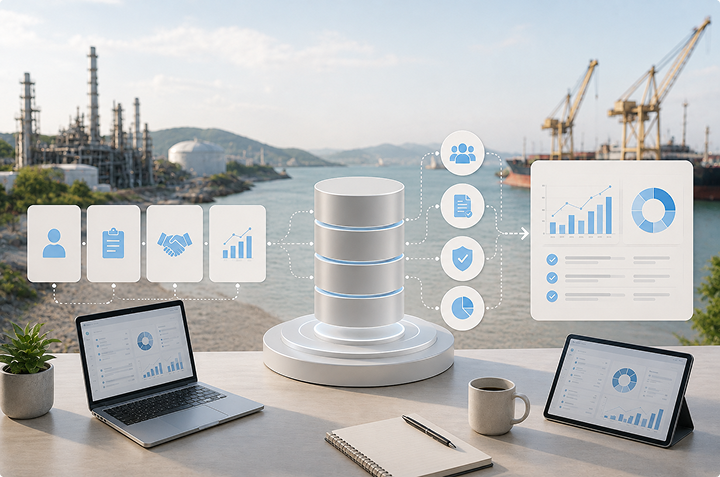
This is precisely the space Dharas’s supplier relationship management platform is built to address. Rather than reconstructing supplier hierarchies after a disruption has already occurred, Dharas’s SRMP gives procurement heads, supply chain managers, and compliance teams continuous, structured visibility into contractor and subcontractor networks, replacing scattered spreadsheets and email trails with a single trusted data source that surfaces sub-tier supplier risk before it becomes a schedule or compliance problem. For operators running newly commissioned refineries, LNG terminals, and mining projects, that shift from reactive firefighting to proactive, tier-by-tier oversight is what turns supply chain mapping from an annual exercise into a genuine source of project resilience.
Conclusion
Multi-tier supply chain visibility is no longer a nice-to-have for capital projects; it is the missing piece that determines whether cost and schedule overruns remain within tolerance or spiral into the 64% to 79% ranges that McKinsey and academic research routinely document. As local content regimes in Guyana, Nigeria, and elsewhere extend compliance obligations deep into subcontractor tiers, and as disruption frequency continues to rise, supply chain managers who cannot see past tier one are, in effect, managing risk blind. Building genuine visibility into sub-tier supplier risk is not a compliance nicety; it is core project delivery discipline.