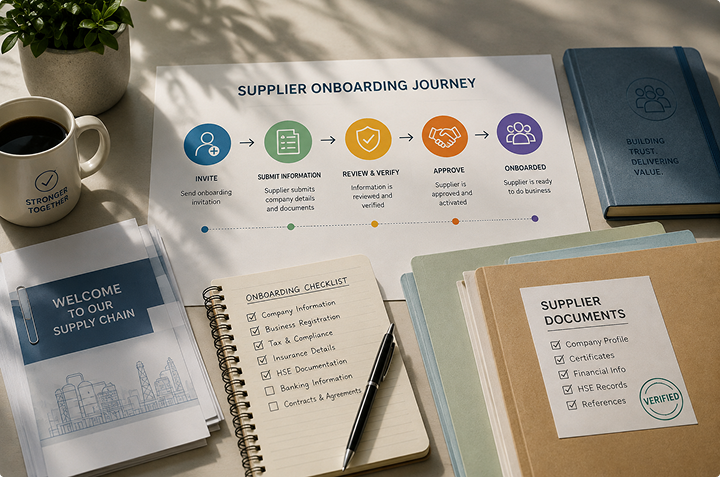
When a new LNG terminal, refinery expansion, or mining operation reaches the construction and commissioning phase, procurement teams are often asked to onboard hundreds, sometimes thousands, of suppliers and subcontractors within a matter of months. Local fabricators, specialist inspection houses, logistics providers, camp catering firms, and international OEMs all need to be vetted, contracted, and made transactable before work can start. On most capital projects, this process still runs through email threads, PDF forms, and shared spreadsheets. It is a model that was never designed for this volume, and the data now shows it is buckling under the weight of modern procurement demand.
This matters more than ever because procurement organisations are under pressure to digitalise. Sixty-five percent of procurement organisations cite digital transformation as their most important initiative heading into 2026, and for 41% of chief procurement officers it is the single strategy expected to deliver the most value, according to Procurement Tactics and Suplari. Yet the foundation many teams are building on, supplier and vendor master data, remains stuck in manual processes that were designed for a handful of vendors, not the scale that large capital projects demand.
The hidden cost of manual onboarding
The economics of manual supplier onboarding are stark once they are actually measured. Analysis based on labour-rate modelling by Epiq, cited by Veridion, puts the fully loaded cost of onboarding a single supplier through manual, high-touch processes at up to $35,000, once procurement, legal, compliance, finance, and IT time, plus the inevitable rework from missing documents and data errors, are all accounted for. Automated onboarding, by contrast, can bring that figure down to $2,400 or less, a reduction of more than 90%.
The picture is similar when you look specifically at sourcing new suppliers rather than processing existing ones. Research from manufacturing sourcing specialist Senturi found that a US company can expect to spend around $12,000 selecting, vetting, and onboarding a new domestic supplier, a figure that climbs to nearly $50,000 for an international supplier further afield, largely due to travel, communication lag, and extended verification cycles (Senturi). For a mega-project onboarding a mix of domestic and international vendors across dozens of workstreams simultaneously, these per-supplier costs compound into a material line item in the project budget, one that rarely gets scrutinised until deadlines slip.
Time is the other casualty. McKinsey has found that a manual supplier search, from identifying a need to shortlisting a handful of candidates out of thousands of possible vendors, typically takes around three months and more than 40 hours of dedicated evaluation work per search (McKinsey). On a project with a fixed commissioning date, that is time procurement teams simply do not have, and it is precisely the kind of delay that pushes teams towards shortcuts, informal vetting, and incomplete documentation just to keep the schedule intact.
Where spreadsheets and email break down at scale
Spreadsheets work reasonably well when a company is tracking a few dozen suppliers. Problems start to compound as volume grows: version control breaks down when multiple stakeholders edit copies independently, formulas fail silently, and there is no reliable audit trail showing who approved what and when. Email exacerbates the issue further. When vendor information such as banking details, certifications, insurance proofs, and sanctions screening results is collected through email attachments and then retyped into spreadsheets or ERP systems, transcription errors are effectively guaranteed, and any error introduced at this stage tends to surface much later as a payment failure, a compliance gap, or a duplicated record.
Capital-intensive industries feel this acutely. In oil and gas specifically, industry commentary in the Journal of Petroleum Technology notes that project data commonly exists across thousands of individual spreadsheets with no central repository, and because reporting is rarely standardised across contractors and disciplines, the underlying information is captured in inconsistent formats from the outset (JPT/SPE). Master data specialist Verdantis notes a related, very specific failure mode on capital projects: urgent, last-minute procurement requests combined with the absence of formal data governance protocols routinely lead to the same supplier or part record being created multiple times in the system, directly inflating procurement costs by fragmenting spend visibility across duplicate entries (Verdantis).
This is not a hypothetical inefficiency. Broader procurement research backs it up: as recently as 2024, nearly half of procurement teams were still losing hours every week fixing spreadsheet errors and manually reconciling records, and only 43% of procurement leaders had made digitisation of these processes an active priority (PLANERGY). Automation is beginning to close the gap; the same research found a 40% reduction in manual procurement workloads in organisations that adopted digital tools, but the starting point for most teams remains manual, fragmented, and error-prone.
Vendor master data: the silent risk multiplier
The consequences of poor supplier master data are not limited to lost productivity. They extend into financial control and fraud exposure, and the scale of the problem is larger than most procurement leaders expect. A fraud-analytics study conducted by SAS on an organisation with 75,000 employees and $16 billion in annual sales uncovered 7,216 vendors registered under different names but sharing the same address, and 4,745 vendors with different names sharing the same bank account. When the analysis turned to transactions, it found 54,127 duplicate invoices for the same vendor and amount above $5,000, representing $4.35 billion in exposure, alongside a further $123 million across 8,379 duplicate invoices issued to different vendors (SAS). Not every one of these overlaps indicates deliberate fraud, many stem from simple data quality failures, but each is a red flag that a manually maintained vendor master will struggle to catch.
This aligns with wider audit findings: roughly 30% of all duplicate payments identified by internal audit teams trace back to duplicate vendor records sitting in the master file, rather than to any error in the transaction itself (Oversight). Risk teams are also discovering these problems too late in the process to act on them. Gartner research shows that 83% of legal and compliance leaders only identify vendor risks after due diligence has already concluded, meaning the supplier is frequently already onboarded and transacting before the issue surfaces (Gartner). For a compliance team on a capital project that must demonstrate clean, auditable supplier records to regulators, lenders, and joint-venture partners, this lag between onboarding and risk detection is precisely the gap that creates reputational and financial exposure.
Why capital projects feel this pain first
Large capital projects magnify every one of these weaknesses simultaneously. Supplier volumes spike within a short window rather than growing gradually, so there is no time to mature a data governance process organically. Multiple departments, procurement, HSE, legal, finance, and local content or compliance teams, each request overlapping information from the same suppliers, often through separate spreadsheets and separate email chains, which is exactly the fragmented, multiple-entry-point scenario that produces duplicate and inconsistent vendor records. Add in the local supplier development requirements typical of extractive and energy megaprojects, where suppliers must be verified not only commercially but against local content, ownership, and capacity criteria, and the volume of data points per supplier multiplies further, each one another opportunity for a spreadsheet cell to go stale or an email to go unanswered.
The digitalisation shift already underway
Procurement organisations are responding, but data readiness is lagging behind ambition. While digital transformation sits at the top of the priority list for most procurement leaders, 74% openly admit their underlying data is not yet AI-ready, a gap driven largely by poor data quality and fragmented systems rather than a lack of appetite for change (Suplari). This is the crux of the problem: organisations are trying to layer analytics, automation, and AI-assisted decision-making on top of vendor master data that was never built for scale or accuracy in the first place. Supplier onboarding software and centralised vendor master data are not simply nice-to-have efficiency tools; they are the prerequisite that makes every subsequent digitalisation initiative viable.
Building a single, trusted source of supplier truth
For procurement heads and supplier management teams running newly commissioned refineries, LNG terminals, mining operations, and petrochemical plants, the lesson from this data is straightforward: supplier onboarding at scale cannot be run reliably through spreadsheets and inboxes, no matter how experienced the team. What is needed is a single, continuously updated source of supplier truth, one where documentation, risk screening, banking details, certifications, and approval workflows live in one auditable system rather than scattered across file versions and email attachments. This is the gap that platforms such as Dharas’s supplier relationship management product are built to close, replacing fragmented manual onboarding with structured workflows, validated vendor master data, and a shared record that procurement, compliance, and project teams can all trust, so that onboarding hundreds of suppliers for a mega-project becomes a controlled, repeatable process rather than a recurring fire drill.