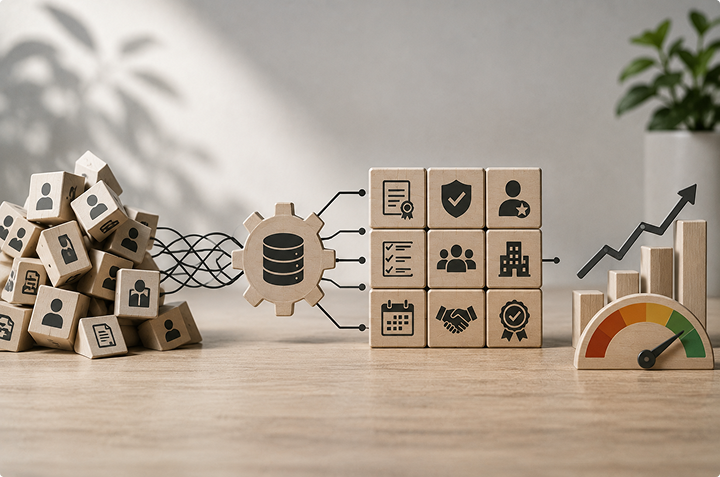
Procurement leaders spend years perfecting sourcing strategy, negotiation playbooks and category management frameworks, yet many of those efforts are quietly undermined by something far less glamorous: the state of their supplier data. Duplicate vendor records, inconsistent naming conventions, outdated certifications and fragmented spend information do not announce themselves the way a failed negotiation or a missed delivery does. Instead, poor supplier data quality erodes procurement performance gradually, through delayed onboarding, duplicate payments, flawed spend analysis and decisions made on incomplete information. For organisations running large, complex supply bases, particularly capital-intensive projects with hundreds or thousands of vendors, the financial and operational consequences of weak vendor master data management are substantial and measurable.
The hidden financial cost of poor data
Data quality problems rarely show up as a single line item on a budget, which is precisely why they are so often underestimated. According to a 2025 IBM Institute for Business Value study, 43% of chief operations officers now identify data quality issues as their single most significant data priority, ahead of security, integration and governance concerns, as reported in IBM’s analysis of the true cost of poor data quality. Forrester’s research goes further on the financial dimension: over a quarter of organisations estimate they lose more than USD 5 million annually because of poor data quality, and 7% report losses of USD 25 million or more, according to Forrester’s report on the cost of poor data quality.
These are not abstract figures confined to IT departments. IBM’s own analysis cites Unity Technologies, which disclosed that inaccurate data ingestion corrupted the datasets feeding its advertising algorithms, resulting in an estimated USD 110 million in lost revenue tied to underperforming models and the cost of rebuilding affected pipelines, as detailed in the same IBM report. Procurement organisations face the same dynamic on a smaller but recurring scale: every duplicate supplier record, every mismatched bank detail and every outdated certification is a small failure that compounds across thousands of transactions.
Why supplier master data breaks down
Supplier master data rarely fails because of one dramatic event. It fails because of accumulation. On multi-site capital projects such as refineries, LNG terminals and mining operations, vendors are frequently onboarded independently by different plants, project sites or business units, each entering the same supplier under a different code, spelling or tax identifier. Industry analysis of oil and gas procurement environments found that a single valve or fitting supplier can end up with three separate vendor codes in the same enterprise system, one from each site that onboarded it independently, each carrying its own banking details and payment terms, as described in CODA Technology Solutions’ analysis of vendor master data in oil and gas. The same analysis notes that audit teams have found that nearly 30% of all duplicate payments uncovered in enterprise systems trace back to duplicate vendor records or coding errors in the vendor master file, rather than genuine invoicing mistakes. When there is no single owner accountable for supplier data quality, duplicate checks depend entirely on whoever happens to be creating the record remembering to search first, and in multi-plant operations that consistency rarely holds.
The consequence is a fragmented data landscape rather than a single, trusted source of truth: multiple vendor masters, suppliers represented differently across systems, missing documentation, inconsistent naming, and hierarchies that no longer reflect who actually owns whom. Reports on procurement’s biggest internal obstacles consistently identify this fragmentation as a defining challenge for large enterprises managing sprawling supply bases.
The link between data quality and procurement KPIs
The connection between supplier data quality and procurement performance is not merely intuitive; it shows up directly in the metrics CPOs are measured against. McKinsey’s research into data-driven procurement found that better data across the sourcing lifecycle, from category strategy development through to supplier performance management, can increase the pipeline of value creation initiatives by up to 200%, according to McKinsey’s analysis of revolutionizing procurement through data and AI. Yet the same research found that CPOs consistently rank data quality and access as one of the three biggest obstacles holding back their digital ambitions: 21% describe their data infrastructure maturity as low, with less than 70% of spend data stored in a single place, and a further 30% describe their maturity as merely average, meaning half of surveyed organisations are operating procurement decisions on data foundations that are not fit for purpose.
The upside, when data quality is addressed, is well documented in McKinsey’s case studies. Pharmaceutical company Sanofi applied clean, structured spend data to should-cost modelling and achieved an average 10% reduction in spend, cut the time required to evaluate tenders by two-thirds, and increased savings achieved through digitally enabled negotiations by 281%. Teva Pharmaceuticals used analytics built on a reliable spend cube to achieve a more than tenfold improvement in supply resilience and cut the time needed to develop category strategies by 90%, per the same McKinsey report. These are not marginal efficiency gains; they are the difference between procurement operating reactively and procurement operating as a strategic function, and the starting point in every case was trustworthy underlying data.
Data quality as the barrier to procurement AI and analytics
As procurement functions push toward automation and AI-assisted decision-making, weak supplier data quality has become the single largest obstacle to adoption. Research from Ardent Partners and Ivalua found that data, whether framed as a quality, availability or structural problem, is cited by 59% of procurement respondents as the primary obstacle standing between their organisation and effective AI-first procurement, according to reporting on the Ardent Partners and Ivalua study. Separate industry research on supplier data specifically found that 74% of procurement leaders say their data is not AI-ready, and 75% cite ongoing data quality problems as actively detracting from their confidence in deploying AI tools against their supplier base, per Supplier.io’s analysis of AI readiness in procurement. This matters because most procurement technology investment now assumes a reasonably clean data layer beneath it; when that layer is unreliable, the return on every subsequent tool, dashboard and algorithm degrades accordingly.
Risk exposure and supplier disruption
Weak supplier data also translates directly into risk exposure. In RapidRatings’ 2025 risk survey, 81% of supply chain and procurement professionals said their business had been impacted by supplier disruption within the past two years, and 62% reported experiencing high or very high levels of supply chain risk in the preceding year, as detailed in RapidRatings’ 2025 Risk Survey Report. Without accurate, current supplier records covering ownership structures, financial health, certifications and site locations, risk teams are effectively assessing exposure with incomplete visibility. For large capital projects, where a single missed compliance renewal or an unnoticed change in vendor ownership can halt a critical delivery, this gap between perceived risk management and actual data completeness is where genuine financial exposure accumulates.
The confidence gap
Perhaps the clearest signal of how widespread this problem is comes not from third-party audits but from procurement teams themselves. Supplier.io’s own research found that 82% of procurement teams lack full confidence in their supplier data, according to its report on the impact of unreliable supplier data. That figure captures the gap between the data procurement teams are working with and the data they would need to make fully informed sourcing, negotiation and risk decisions. It is a gap that spreadsheets, shared inboxes and disconnected point solutions have consistently failed to close, because none of them establish accountability for a supplier record once it has been created.
Building a single, trusted source of supplier truth
Closing that gap requires more than periodic data cleansing projects; it requires a system of record where supplier information is created once, validated continuously, and shared consistently across procurement, finance and project teams, rather than re-entered and reconciled manually at every site. This is the problem that Dharas’s supplier relationship management platform (SRMP) is built to solve for owners and operators of large capital projects. By centralising supplier onboarding, qualification, performance and risk data into a single governed platform, Dharas replaces the fragmented vendor masters and email-based tracking that typically accumulate across multi-site refineries, LNG terminals and mining operations with continuous, audit-ready supplier data that procurement, compliance and project teams can all trust and act on.
Supplier data quality is not a peripheral IT concern for procurement functions; it is the foundation on which sourcing decisions, cost savings, cycle times and risk exposure all rest. Organisations that treat vendor master data management as a strategic discipline, rather than an occasional clean-up exercise, are the ones capturing the value that better data makes possible.