What Supplier Relationship Management Actually Is – and Why Capital Projects Get It Last
12 min read•30 October 2026
Ask five procurement professionals to define supplier relationship management and you will get five answers. That is not a failure of the profession. It is a reasonable response to a field in which no body with real standing has published an authoritative definition.
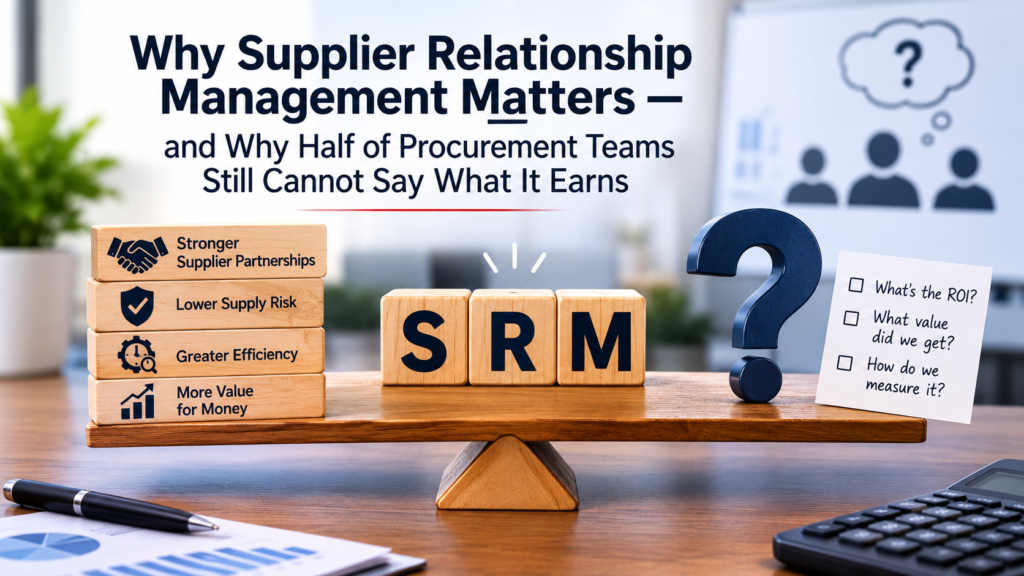
That sounds like a throwaway observation. It is not. It explains why SRM is the easiest function to under-resource, the hardest to budget for, and the first thing dropped when a capital project runs late – because nobody can point to the standard that says what it is.
So it is worth starting with what the field’s institutions actually say, in their own words.
What the institutions actually say
CIPS – the Chartered Institute of Procurement & Supply – offers the clearest one-line definition available:
Supplier relationship management is the management and maintenance of the relationship between a buyer and supplier.
CIPS is also useful on where SRM sits. Its Procurement and Supply Cycle runs to thirteen stages, and places Performance at stage 11 and Supplier Relationship Management at stage 12 – two separate, sequential stages, both after contract award. CIPS adds that “Supplier relationship management (SRM) is an important part of supply chain management (SCM)”, and that “Time devoted to SRM depends on your strategy, type of purchase, length of contract.”
That ordering is the closest thing to an authoritative structural distinction between supplier performance management and supplier relationship management anywhere in the field.
ISO declined to standardize SRM at all. What it standardized instead is ISO 44001:2017, “Collaborative business relationship management systems – Requirements and framework” (Edition 1, published March 2017, reviewed and confirmed in 2022, with Amendment 1:2024 on climate action changes; a draft revision is in development, and there is no 2026 edition). Its scope:
ISO 44001:2017 specifies requirements for the effective identification, development and management of collaborative business relationships within or between organizations.
The vocabulary choice is deliberate and it matters. ISO’s technical committee is named Collaborative business relationship management, and the standard covers relationships “within or between organizations” – bilateral and symmetric, not buyer-side. ISO looked at this territory and standardized a two-way discipline rather than a buyer-centric one. ISO 44002:2019 gives implementation guidance.
For capital projects there is a useful detail in that scope: ISO 44001 explicitly names a project, a joint venture and a supply chain among the levels at which it can be applied. The standard anticipates project-level use.
APQC, whose Process Classification Framework is the most widely used open process taxonomy in existence, avoids the word “relationship” entirely. In PCF Cross-Industry version 7.4 (2024) there is no element called supplier relationship management. There is:
4.2.4 Manage suppliers (10280), decomposed into
4.2.4.1 Monitor/Manage supplier information (10299)
4.2.4.2 Prepare/Analyze procurement and supplier performance (10300)
4.2.4.3 Support inventory and production processes (10301)
4.2.4.4 Monitor quality of product delivered (10302)
with 4.2.2.2 Certify and validate suppliers (10289) and 4.2.2.4 Manage contracts (10291) sitting upstream.
A senior reader should find this more useful than another definition. The world’s standard process taxonomy says that managing suppliers is managing supplier information, supplier performance, supplier certification and the contract link. That is a functional specification, written by a process body rather than a software vendor.
ISM publishes no free, citable definition of SRM. Its glossary material sits behind its certification learning systems.
The distinctions nobody has drawn
Three boundaries get argued about constantly, and it is worth saying plainly which of them are actually settled.
SRM versus supplier performance management is settled, loosely, by CIPS’s own cycle: performance measurement at stage 11, relationship management at stage 12. Measuring how a supplier did and managing what you do about it are different activities. APQC agrees structurally, treating performance analysis as a sub-process of managing suppliers rather than a peer discipline.
SRM versus supply chain management is settled by CIPS in one sentence: SRM is a part of SCM, not a synonym for it.
SRM versus vendor management is not settled by anyone. The term “vendor management” does not appear as a defined term in the CIPS material, in ISO 44001 or 44002, or in APQC’s framework. It is industry vernacular with no standards-body definition, used interchangeably with SRM. If someone tells you there is a rigorous distinction, ask them for the source.
Segmentation deserves one correction, because it is the most frequently misattributed idea in procurement. Peter Kraljic’s “Purchasing Must Become Supply Management” (Harvard Business Review, September 1983) is real and foundational – but it segments what you buy by supply-market risk and profit impact, producing purchasing strategies. It is a purchasing portfolio model. The practice of segmenting who you buy from, and varying management intensity accordingly is a later extension with no single canonical author. For relationship intensity specifically, the better citation is the CIPS Relationship Spectrum, which runs from adversarial and arm’s-length through to partnership and co-destiny, ties the choice to “the criticality of the goods”, and reserves the high-commitment end for “strategic suppliers or critical high-risk, high-value supply.”
How mature is the field, really
Here the evidence is unflattering and consistent.
State of Flux’s Global SRM Research, now in its seventeenth year and drawing on more than 480 senior procurement and supply chain professionals from 330 organisations, found that just 6% of organisations demonstrate mature SRM capability (reported November 2025). An eighteenth edition, themed “Making SRM Stick”, was fielded to 1 July 2026 and had not published as of late October 2026.
PwC’s Global Digital Procurement Survey, 5th Global Edition (February 2024, 1,000 procurement departments across 58 countries), asked about collaborative supplier tools and platforms. The answers:
Response
Share
No added value
21%
Opportunity identified, no suitable solution on the market
30%
Proof of concept in progress
24%
A platform is already in place, for procurement only
19%
A platform is already in place for the entire ecosystem
6%
So 25% had any collaborative supplier platform live, and 6% had one covering the whole ecosystem. Set that against the same survey’s finding that “the use of source-to-pay solutions is now the norm, with 94% of survey respondents reporting that they use such platforms.”
That gap is the single most revealing number in this article. Procurement has comprehensively digitized the transaction — the requisition, the purchase order, the invoice – and has largely not digitized the counterparty. PwC’s own commentary notes that large companies “often have very extensive supplier panels (over 5,000 suppliers)”, and that firms “need to improve visibility beyond their tier 1 suppliers and streamline data sharing between stakeholders.”
Achilles’ 2026 survey of 2,805 organizations across sectors including construction and energy found only 6% report full visibility beyond their tier-1 suppliers, with nearly half reporting limited or no visibility past their immediate supplier base. (Achilles’ own summary words this figure slightly differently in two places; the formulation above is the conservative reading.)
Deloitte’s 2025 Global Chief Procurement Officer Survey (19 August 2025, over 250 CPOs across 40 countries, now in its twelfth year) asked how CPOs are mitigating risk. The top three answers were maintaining active alternative sources (74%), enabling greater visibility into the supply chain (64%), and enhancing supplier information sharing and collaboration (61%).
Read that list again. Every one of the top three is a supplier-information problem. None is a sourcing-event problem. The profession’s own stated priorities are squarely in SRM territory, and 6% of it is mature there.
The Hackett Group’s 2026 Procurement Agenda (17 March 2026) adds the constraint: procurement workloads are projected to increase by 8% in 2026 “even as head count and operating budgets decline”, with 43% of organisations actively pursuing AI deployment but only 12% reporting large-scale implementation. One caveat worth stating: Hackett does not publish its sample size or fielding period for this study.
Why capital projects are the hardest case
Everything above is true of procurement generally. On a large capital project it is sharper, for four structural reasons.
First, the supplier base is created once, under schedule pressure, and then inherited. A refinery, LNG train or mine assembles its entire supplier population during execution – package by package, split between the EPC contractor and the owner – and then hands it to an operating organization that will live with it for decades. That handover is not governed by any standard. The industry has built one for engineering and asset information: CFIHOS, which became IOGP JIP36 in 2020, exists so that owners have “the information they need to operate, maintain and decommission a facility.” There is no equivalent for the commercial and supplier record, and no published research on it.
Second, the industry’s own research institute says the field is unstudied. The Construction Industry Institute, on its supply chain management page, puts it bluntly:
The supply chain is among the most understudied areas of capital projects.
That is CII describing its own field, and it is the most honest sentence in this article.
Third, the sector has standardised everything except the commercial relationship. IOGP publishes detailed guidance on contractor HSE capability assessment (Report 423), standardised equipment procurement specifications (JIP33), and information handover (JIP36/CFIHOS). None of it defines or structures the commercial management of suppliers. We could find no definition of supplier management or SRM for capital projects from IOGP, API, CII, IPA or the Energy Institute.
Fourth, nobody even knows how many suppliers a project has. There is no published figure for the number of suppliers engaged by a refinery, an LNG train or a mine. The only usable public data remains BIS Research Paper No. 145, prepared by EC Harris for the UK Department for Business, Innovation and Skills in October 2013 – thirteen years old, UK only, and about building construction rather than process plant. Within those limits it found that “To have 50 to 70 Tier 2 suppliers and sub-contractors is not uncommon”; that main contractors “may access a project supply chain of over 40 subcontractors and suppliers to deliver a typical £10 million plus contract”; that “between 50% and 75% of the total value of the work is accounted for by a small number of major Tier 2 sub-contractors”; that complex tier-2 subcontracts “typically featur[e] over 30 suppliers at Tier 3”, with one package carrying over 100 separate suppliers; and that there are “at least three tiers within the supply chain.”
That is the best evidence available, and it is about office blocks.
Against that unmeasured base, the outcome data is well measured and poor. McKinsey’s November 2024 analysis of 80 global mining projects found that “cost and scheduling challenges affect 83 percent of recent major mining and metals projects”, with real cost overruns averaging approximately 40% and schedule delays approximately 25% over the decade – and for megaprojects with budgets of $1 billion or more, cost overruns “at least 79 percent higher than initial budget estimates” and delays averaging “52 percent higher than initial time frames”. Only 42% of projects came in with cost overruns under 10%.
HKA’s ninth annual CRUX Insight report, “Powering through uncertainty”, launched on 15 October 2026, now draws on more than 2,410 projects across 122 countries with a total project value of US$2.56 trillion – the largest dataset of its kind, and a measure of how routine disputed capital projects have become.
So what does an SRM system actually have to do?
There is no standards-body specification for SRM software. Gartner and Forrester category definitions are paywalled; everything else is vendor marketing. But two legitimate sources give a functional answer between them.
APQC’s taxonomy says managing suppliers decomposes into supplier information, supplier performance, certification and validation, and the contract link.
PwC names three functions SRM tools perform: transferring certain tasks to suppliers, maintaining visibility of supplier performance, and managing risk through supplier dashboards.
Underneath all of it sits a problem the data-quality standards community has actually addressed. ISO 8000-116:2019 applies the ISO 8000 quality-identifier requirements to authoritative legal entity identifiers – the problem of knowing, unambiguously, which legal entity you are contracting with. On a project with hundreds of counterparties across multiple jurisdictions, joint ventures, local subsidiaries and consortium structures, that is not an administrative nicety. It is the foundation on which every local content calculation, every tier-2 question and every performance record ultimately rests. (ISO 8000’s parts have moved recently: Part 115 is now the 2024 edition, Part 118 is 2025, and a Part 119 was published in 2026.)
Put concretely, on a capital project the supplier record has to carry: the legal identity and ownership of the counterparty; its qualification and prequalification status; its certificates, their issuers and their expiry dates; its performance history against the packages it delivered; its position in the contract structure and who sits below it; and – in any jurisdiction with a local content regime – the ownership, workforce and registration attributes that determine whether its spend counts at all.
None of that is exotic. All of it is the difference between a supplier base that transfers to operations and one that has to be rebuilt from purchase orders. Holding those attributes as structured, dated, re-queryable fields against the supplier – rather than scattered across package folders and a spreadsheet owned by whoever is still on the project – is precisely what a supplier relationship management platform like Dharas exists to do, and it is why the question is better asked at FID than at handover.
The honest summary
Supplier relationship management is the post-award discipline of managing the counterparties you have already chosen: their information, their performance, their qualification and their contracts. CIPS defines it in a line, ISO standardised a broader and more symmetric version of it, and APQC describes it as a process rather than a relationship. No one has written the capital-projects version.
Only about 6% of organisations do it maturely. About a quarter have any platform for it, against 94% who have digitised their transactions. And the industry body closest to the problem says the supply chain is among the most understudied areas of capital projects.
For a procurement head standing up a new refinery, LNG facility or mine, that is not a reason to despair. It is a reason to be deliberate – because the supplier base being assembled right now, under schedule pressure, is the one the operating organisation will still be living with in 2050, and nobody downstream will be able to reconstruct what was never recorded.