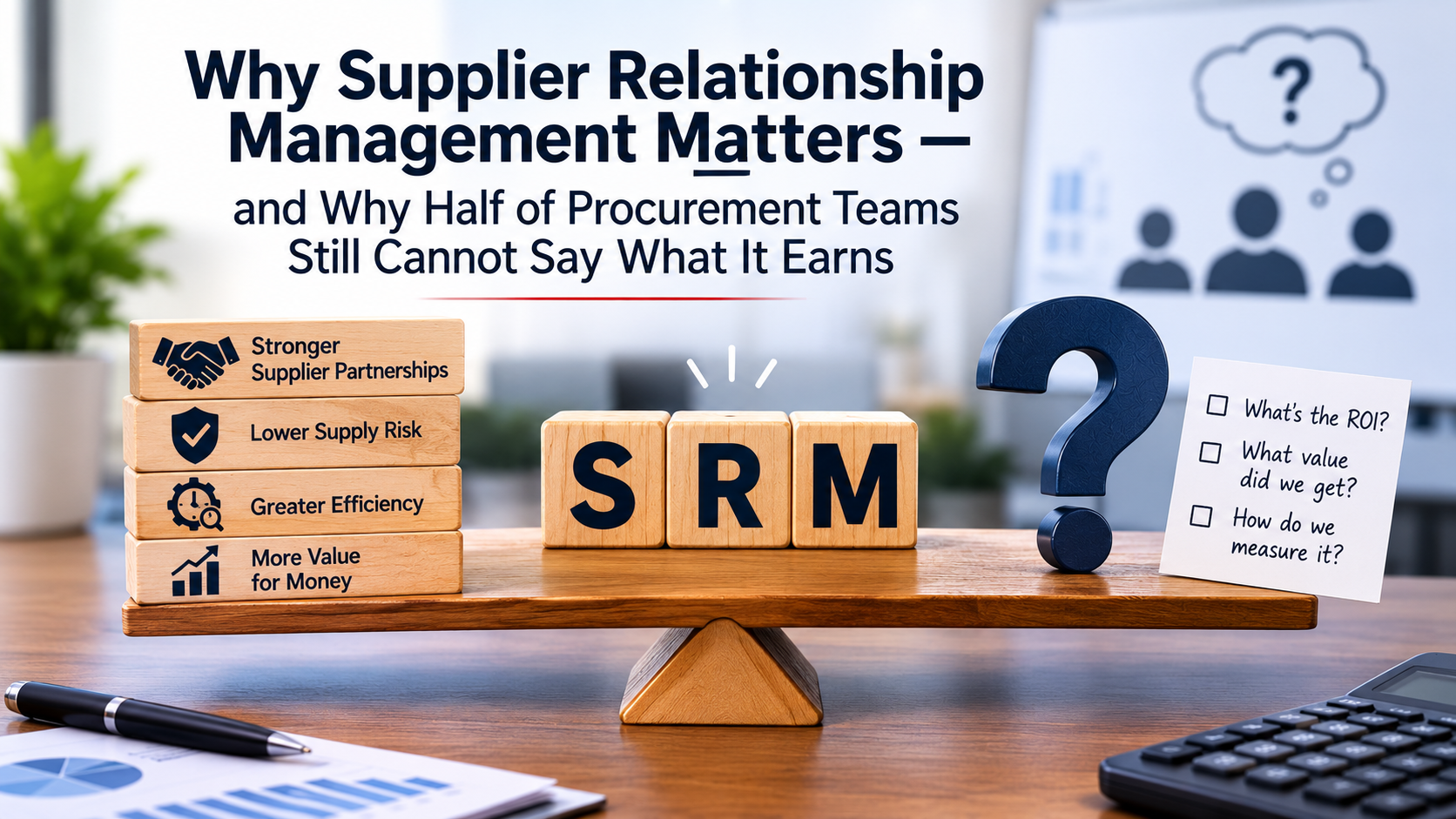
Supplier relationship management has an unusual problem for a business function. It is not that people think it is worthless. It is that the people running it frequently cannot say what it is worth, and so it loses every budget argument it enters.
That is not an impression. It is the headline finding of the 2026 Global SRM Research from State of Flux, presented at the firm’s annual summit on 3 November 2026 and published on 5 November – now in its eighteenth year, assessing 387 participants from 284 organizations against six pillars of supplier management.
The number that should stop a procurement head: 49% of respondents do not know what financial benefit their supplier management programme delivers. That is an improvement – it was 57% in 2025 – but it still means that in roughly half of organizations, the function cannot answer the first question any finance director asks. A further 37% have no clearly defined annual targets for it.
Against that, the maturity distribution: 6% qualified as Leaders, 21% as Fast Followers and 73% as Followers.
The value gap is a measurement gap
The research separates what Leaders do from what everyone else does, and the separation is not subtle.
- An SRM strategy fully aligned with organisational objectives: 76% of Leaders, 14% of Followers.
- Joint planning with suppliers: 94% versus 38%.
- Performance objectives and KPIs linked to supplier management: 94% versus 44%.
- Treatment strategies defined for all supplier types: 88% versus 15%.
- All Leaders now capture or monitor financial benefits above contracted spend, up from 94% the previous year, and all of them report cost savings and avoidance as a benefit.
Read those five lines together and the causality is hard to miss. The Leaders are not winning because they care more. They are winning because they decided in advance what the relationship was supposed to produce, wrote it down as an objective, and measured it. Everyone else is doing supplier management and hoping someone notices.
The research is equally clear about where the weakness sits. Scored across the sample, People is the lowest of the six pillars at 30%, followed by Technology at 34% and Governance at 40%; Engagement, at 52%, is the only all-respondent score to reach the Established level. Inside the People pillar, 48% have defined the main SRM role and 45% have implemented SRM training – but only 18% have completed an individual SRM skills and competency assessment, down from 26% the previous year. The capability is going backwards while the ambition goes forwards.
And the internal politics are stated outright: 40% of respondents say internal procurement colleagues lack knowledge of the value supplier management delivers, with the same proportion reporting a lack of understanding of what supplier management even is. The summary line from the research is worth repeating verbatim: “Execs get it. Middle management with the budgets don’t.”
Why a capital project is the hardest version of this problem
Everything above is true of any large organisation. On a newly commissioned refinery, LNG train or mine it is worse, for a reason that has nothing to do with procurement competence.
A capital project builds its supply base once, under schedule pressure, package by package, split between the owner and the EPC contractor – and then hands it over. Every other system in the plant is commissioned before that handover. Vessels are pressure-tested. Instruments are loop-checked. Control systems are site-accepted. Each one gets a certificate and a signature.
The supplier base gets none of that. It is the only part of a new asset that is transferred without ever being tested, to an operating organisation that did not select it, cannot see how it was selected, and will live with it for thirty years.
The Construction Industry Institute puts the research position plainly: “The supply chain is among the most understudied areas of capital projects.”
The nearest thing to a structured test is Independent Project Analysis’s Production Readiness Assessment, which measures progress across more than 30 production readiness activities. Procurement sits inside it – Logistics and Support Systems Readiness covers “procurement planning based on required inventory levels and spare parts; decisions on support services and retention of such services”, Asset Readiness covers “vendor support during commissioning and change management during startup”, and People Readiness covers the staffing, experience and training of the operations and maintenance teams. IPA’s own published figures on what happens when readiness is thin are sobering, if dated: in a 2014 study of upstream projects, those carrying fabrication work offshore faced a 65% probability of an operability problem within the first year, and “Those projects achieved production attainment of just 67 percent.” An earlier operability study found plant operators identifying technical or mechanical engineering and construction errors in approximately half the projects reviewed, with those projects suffering “11 percent worse operability, on average.”
IPA does not attribute those outcomes to procurement, and nor should anyone else. The relevant point is narrower and harder to argue with: the industry’s own readiness framework treats spare parts provisioning, vendor support and support-service retention as readiness activities that have to be complete before startup – and on most projects nobody owns them, because the project procurement team is demobilizing exactly when they fall due.
What the operating organisation actually inherits
Strip the abstraction away and a new plant’s procurement function wakes up on day one holding a set of obligations it did not negotiate:
- Vendors whose qualification status is already expiring. Certificates – ICV, local content, quality system, hazardous area – were current at award. Several will not be current at first maintenance.
- Warranties running on clocks that started at shipment. The market-standard formula runs twelve months from start-up or eighteen months from shipment, whichever ends first, and on long-lead equipment the second clock routinely wins.
- A service agreement nobody in operations negotiated. Long-term service agreements are typically entered into with the initial sale of the equipment and run five to fifteen years, during which an independent provider generally cannot compete for the work.
- A spare parts position chosen for construction, not for operation. The mandatory handover artefact is the vendor’s own recommended spares list; the owner’s analytical judgement about criticality and obsolescence is not a required deliverable anywhere in the industry handover standard.
- A tier-two and tier-three supply base nobody has seen. Even among the Leaders in the 2026 research, only 53% have fully mapped their supply chain through multiple tiers.
Each of those is a supplier data problem before it is a commercial one. And the 2026 research shows how most organisations are currently handling the relationship side of it: across the sample, 51% still rely on ad hoc conversations to gather supplier feedback and 23% gather none at all. Even among Leaders, only 20% use dedicated supplier-governance and relationship-management technology.
So what is SRM actually for?
The honest answer, for a capital project, is not “better relationships”. It is four concrete things, each of which can be measured and therefore defended:
- It keeps the record that the operating phase runs on. Who the supplier is, what they are qualified for, until when, under which contract, with what obligations outstanding. Nothing downstream can reconstruct this; the project is the only moment it exists.
- It holds the commercial clocks. Warranty expiry, certificate expiry, service agreement renewal and notice periods are dates, and dates that nobody owns are dates that pass.
- It makes performance a fact rather than an opinion. The research’s Leader-versus-Follower gap on KPIs linked to supplier management – 94% against 44% – is the whole argument. A supplier you cannot score is a supplier you cannot manage, replace or defend keeping.
- It segments honestly. One of the research’s own recommendations is to “stop calling every important supplier strategic.” A project that treats 2,000 vendors as equally important manages none of them.
That is also the practical brief for a supplier relationship management platform on a capital project – which is what Dharas is built for: carrying the vendor record, qualification and certificate currency, contractual clocks and performance history from the project organization into the operating one, so that the handover transfers something more than a vendor list. The function’s value becomes measurable at the point where the record becomes continuous.
Because the finding to take from the 2026 research is not that supplier management fails. It is that in half of organizations nobody can prove it succeeded – and on a capital project, the proof has to be built during execution, or it does not get built at all.
Honest negatives
State of Flux does not publish the fielding period or the country and sector breakdown of the 387 participants, and the 6% figure is reported against respondents rather than organisations; the firm’s 2025 edition reported 6% with mature SRM capability on a differently labelled scale, so the two should not be read as a trend. The IPA operability figures date from a 2014 study published in 2016 and are not attributed to procurement. No capital-project-specific SRM maturity benchmark exists, and no published study measures the handover of supplier or vendor master data from an EPC contractor to an owner-operator – the absence has now held across several years of searching.